
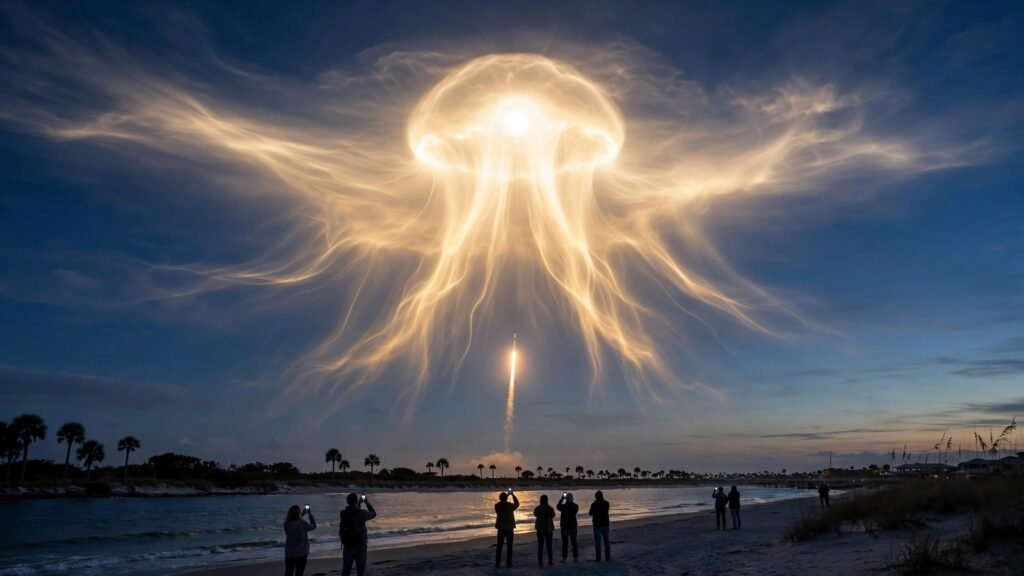
A Giant Glowing “Jellyfish” Lit Up the Sky Over Florida — and It Wasn’t a UFO
People Looked Up — and Saw a Jellyfish in the Sky
Early risers across Florida got a strange surprise on Tuesday morning, October 20. High above the coast, a huge glowing shape hung in the dark dawn sky — a bright round “head” with long, flowing tendrils trailing beneath it, like a giant jellyfish drifting through space. Photos and videos poured onto social media within minutes. It was not a UFO, and it was not dangerous. It was a “space jellyfish” — one of the most beautiful side effects of a rocket launch, created when SpaceX’s Falcon 9 lifted off from Cape Canaveral Space Force Station at 7:04 a.m. ET on the Bandwagon-5 mission.
What Actually Causes a Space Jellyfish?
The secret is timing. A space jellyfish can only appear in the few minutes just before sunrise or just after sunset, and it needs three things to line up:
- A dark ground: down at the surface, the sky still looks like night.
- Sunlight up high: far above the Earth, the sun’s rays are already shining — the upper atmosphere is in daylight even when the ground is not.
- A rocket climbing through both: as the Falcon 9 rises, its exhaust plume expands in the thin upper air and forms tiny ice crystals.
When the plume reaches the sunlit layer, those ice crystals catch the light and glow against the dark sky below — spreading into the round head and flowing tendrils that give the space jellyfish its name. The effect can last for several minutes, and in some cases the glowing shape is still visible more than an hour later.
Seen Hundreds of Miles Away
This was no local curiosity. The October 20 jellyfish was photographed from Seminole near Tampa Bay on Florida’s west coast, and reported from Fort Myers, West Palm Beach and Daytona Beach — hundreds of miles from the launch pad. Viewers as far away as Ohio were watching the southeastern sky for a glimpse. Remarkably, it was the second space jellyfish over Florida in a single week: a 6:35 a.m. launch on October 13 produced one too, and for some viewers that contrail even curled into the shape of a heart. Floridians who follow launches have a saying for it — the space jellyfish is their Northern Lights.
How Can You See One?
You do not need a telescope — just the right launch at the right time. Dawn and dusk launches are the ones to watch, especially in the minutes before sunrise. Stand somewhere with a clear view toward the launch site, look up a few minutes after liftoff, and if the skies are clear, the jellyfish may bloom overhead. And if you ever see a glowing jellyfish in the sky, do not panic: it is physics and sunlight putting on a show — and it means a rocket just went to space.
Sources: Florida Today and the Cincinnati Enquirer (USA TODAY Network), reporting on the October 20, 2026 launch.
Related: One Rocket, 32 Satellites: SpaceX’s Bandwagon-5 Puts NASA’s Future Space Network to the Test