
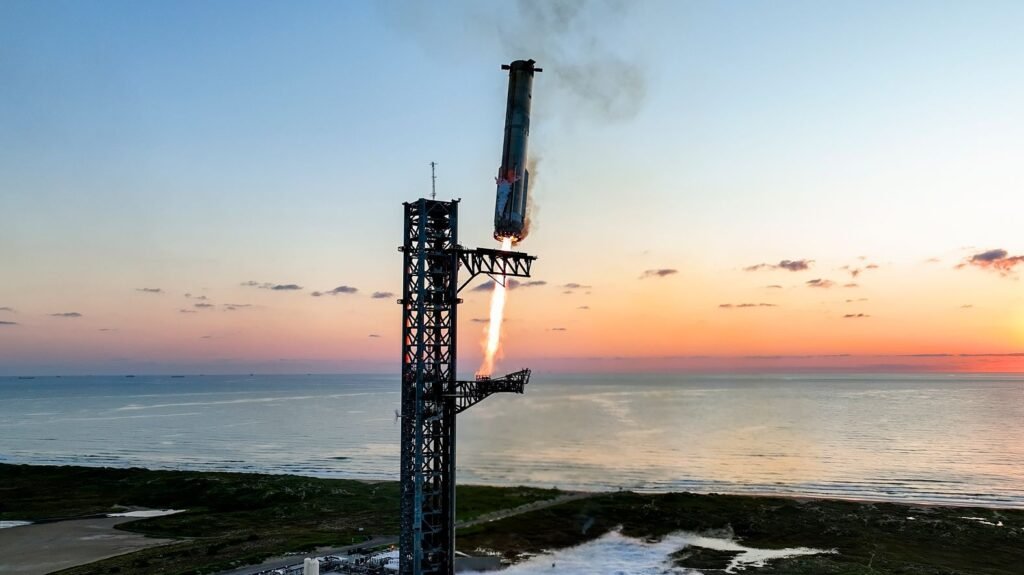
SpaceX Will Try to Catch Both Halves of Starship in Mid-Air Next Month — a First in Spaceflight History
SpaceX is about to attempt something no space company has ever pulled off: catching an entire orbital rocket out of the sky — both halves of it — in a single flight.
Speaking on SpaceX’s third-quarter earnings call on Tuesday (Oct. 20), CEO Elon Musk confirmed that Starship Flight 15, expected next month, will attempt to catch the Super Heavy booster and the Starship spacecraft itself using the giant mechanical arms on the launch tower. If the plan works, Musk said, “it will be the first time that an orbital launch vehicle has been fully recovered.”
Until now, every rocket in history has either burned up, crashed into the ocean, or come back only in pieces. SpaceX has already caught the Super Heavy booster with the tower’s so-called “chopstick” arms on earlier flights — a sight that looked like science fiction the first time it happened. But the upper stage, the ship that actually goes to orbit, has never been caught. Flight 15 aims to do both, one after the other, on the same mission.
Why a double catch is such a big deal
Starship is the largest and most powerful rocket ever built, standing more than 400 feet (122 meters) tall when stacked. Both of its stages were designed from the start to be fully and rapidly reusable, and catching them at the tower — instead of landing them on pads or ships far away — is what makes that rapid reuse possible. A caught rocket can, in principle, be inspected, refueled and flown again far faster than one that has to be fished out of the ocean.
That speed is central to SpaceX’s plans. Starship is the vehicle NASA has chosen to land astronauts on the Moon under the Artemis program, and it is the backbone of Musk’s long-term Mars ambitions. During the call, SpaceX even played a simulation of Flight 15 showing exactly how the double catch would unfold, ending with the ship descending back into the tower’s arms.
“More likely than not” — but no date yet
Musk was careful not to promise success. “Success is not guaranteed on these first flights,” he said, “but I’d say it’s more likely than not that this succeeds next flight.” If Flight 15 falls short, he added, SpaceX has “a steady stream of Starship flight attempts through the end of this year and then accelerating next year,” with a goal of flying Starship weekly in the first half of 2027.
SpaceX President Gwynne Shotwell added that the company has had “significant constructive engagement with the FAA” and expects the Flight 15 license to include returning both stages to the launch site for the tower catches. SpaceX has not announced an exact launch date yet — only that the flight is expected next month (November 2026) — and as always with Starship, the schedule can move.
The attempt builds on real momentum: on Flight 14 last month, Starship reached orbit for the first time and deployed operational Starlink V3 satellites. Now comes the recovery test that could change rocketry for good. When Flight 15 lifts off from Starbase in Texas, both the booster and the ship are meant to come home to the same tower — and if both are caught, spaceflight will never work the same way again.
Source: SpaceX Q3 2026 earnings call (Oct. 20, 2026), as reported by Space.com and The Wall Street Journal.