
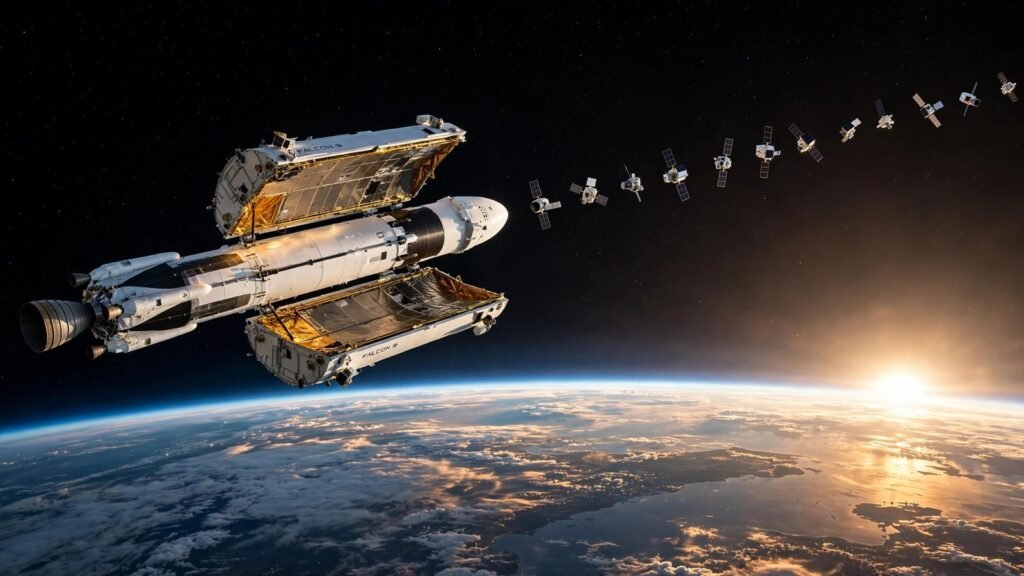
One Rocket, 32 Satellites: SpaceX’s Bandwagon-5 Puts NASA’s Future Space Network to the Test
A single SpaceX Falcon 9 rocket lifted off from Cape Canaveral at 7:04 a.m. ET on Tuesday, October 20 — and it was carrying far more than satellites. With 32 payloads on board, the Bandwagon-5 rideshare mission also carried a quiet test of how NASA will communicate with its spacecraft for decades to come.
The rocket, flying from Space Launch Complex 40 at Cape Canaveral Space Force Station in Florida, deployed all 32 payloads into low Earth orbit, SpaceX confirmed. Its first-stage booster, B1085, was flying for the 19th time and landed on the droneship A Shortfall of Gravitas in the Atlantic about nine minutes after liftoff. Because the launch happened before dawn, the rocket’s exhaust plume lit up in the sunlight high above Florida, creating the glowing “space jellyfish” effect seen across the state.
NASA’s new space network, tested in public
Two of the payloads belong to a much bigger story. NASA is gradually retiring its own Tracking and Data Relay Satellite (TDRS) fleet — the system that has relayed data between spacecraft and Earth for decades — and plans to buy that service from commercial companies instead.
Through its Communications Services Project (CSP), managed by NASA’s Glenn Research Center, the agency awarded $278.5 million in 2022 to industry partners to build and prove those commercial relay services. Bandwagon-5 carried two of the demonstrations:
- Viasat’s Maxwell spacecraft, built by Rocket Lab, will test high- and low-rate relay services, using autonomous technology to route data between the spacecraft, Viasat’s satellites in geosynchronous orbit, and ground stations around the world.
- SES Space & Defense flew a demonstration payload on Planet Labs’ Pelican-12 satellite. It will use the O3b mPOWER fleet in medium Earth orbit for high-rate data and geosynchronous satellites for low-rate signals.
Over the coming weeks, both systems will be exercised to show they can keep spacecraft connected at any point in their flight — the same job TDRS does today. NASA plans to keep testing commercial relay capabilities through 2027.
A rocket-pool for everyone else
The rest of the manifest shows how routine rideshare has become. The largest customer was Xona Space Systems, which flew six satellites as it prepares to start a commercial navigation service — effectively a private, more precise complement to GPS. Portal Space Systems flew Starburst-1, a maneuverability spacecraft set to demonstrate rendezvous and proximity operations. Weather company Tomorrow.io added two satellites, HawkEye 360 flew three radio-frequency sensing satellites, PlanetiQ launched its GNOMES-11 weather satellite, and SpaceX itself included a demonstration of its Starfall re-entry capsule, designed to bring experiments back to Earth.
Bandwagon missions head to mid-inclination orbit and are SpaceX’s answer to a simple reality of the new space age: there are far more small satellites than rockets, so they share the ride — and split the bill.
Sources: NASA (Communications Services Project update, Oct 20, 2026); Via Satellite (launch report, Oct 20, 2026). Featured image: original Space PAKNN illustration.
Related: SpaceX Will Try to Catch Both Halves of Starship in Mid-Air Next Month
Pingback: Glowing "Space Jellyfish" Over Florida: What It Really Is